

Serving the Valley for 55 Years
The Story of FISH, Part 1: Neighbors Helping Neighbors
When FISH was founded in 1971, it was one of hundreds of volunteer “Fish” groups that were formed throughout the country in response to a Readers Digest article titled “A Friendly Neighbor Called Fish”. The article highlighted a grassroots service group led by an Anglican minister in a small town in England. It was not until FISH became a legal nonprofit organization in 1975 that the name needed to be modified for official purposes. Aptly, the founders chose Friends In Sonoma Helping.
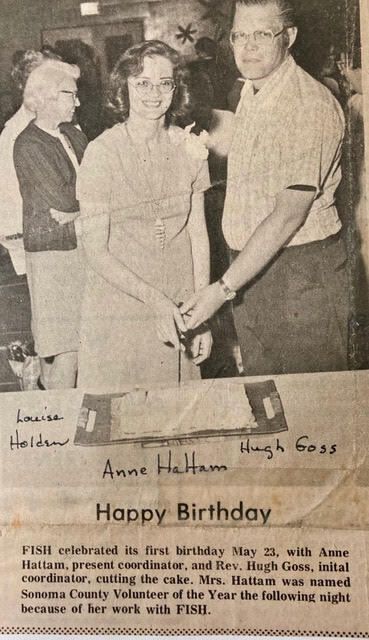
A handful of local churches in Sonoma Valley came together to form FISH, under leadership from Reverend Hugh Goss of St. Andrews Presbyterian, along with Jerry Casson and Anne Hattam. Early volunteers received calls at home and provided food from their own cupboards and clothing from their own closets. FISH volunteers also helped with rides, emergency childcare and reassurance to shut-ins. Neighbors helping neighbors. The story of FISH is the story of a caring community.
The Story of FISH, Part 2: The Patty Hearst Connection
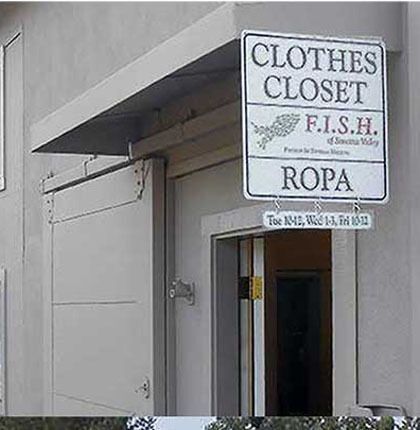
In its earliest years, FISH was a shoestring operation of participating churches, including St. Andrews, Faith Lutheran (home to the first Clothes Closet), Trinity Episcopal (home to the first Food Pantry), First Congregational, Methodist Church, St. Francis, St. Leo’s, Grace Reformed, and Seventh Day Adventist.
In February 1974, Patty Hearst, the granddaughter of newspaper tycoon William Randolf Hearst, was kidnapped from her Berkeley apartment. As part of her ransom, the kidnappers demanded that the Hearst family fund millions of dollars of free food distribution through a program called People In Need.
In March 1974, an ad hoc group of Anne Hattam, Roberta Dixon, Adele Harrison, Father Pat Moriarty and Rev. Alan Piotter met to discuss the possibility of FISH accepting money and food from the People In Need program. After discussion, the decision was made to reject this outside, ransom-based money but to appeal through the churches for additional donations to expand FISH and its food program to be able to serve more local residents in need.
This decision had a far-reaching impact. The word spread beyond the churches, and FISH received an outpouring of food and financial donations from throughout the Sonoma Valley community, enabling purchase of a refrigerator and freezer and a new food distribution structure. By the end of the year, the budget had tripled. FISH had taken its first step from a faith-based organization to a community-based organization.
The Story of FISH, Part 3: The Ultimate Volunteer
Adele Harrison served as the coordinator of FISH for 27 years, until the year 2000. A social worker by training, she led the fledgling nonprofit organization through a period of immense growth. Rides through a "Care-a-Van", food assistance, layettes for new babies, clothing, rental assistance, providing support to Vietnamese refugees who fled after the fall of Saigon, and even an emergency shelter as well as an overnight shelter were all provided by FISH at some point during her tenure. FISH also helped "incubate" several other local nonprofits, including the local Meals on Wheels, Vintage House, and La Luz Center.
Adele frequently contributed more than 40 hours a week in this volunteer role. In a profile in the Sonoma Index Tribune at her retirement, Adele was described as "the ultimate volunteer. Compassionate. Intelligent. She is soft-spoken, yet articulate. Mild-mannered, yet fiercely passionate about caring for others."
According to Adele, "the reason we've lasted so long is because we consider all our clients neighbors. We are not benefactors. We are people helping our neighbors."
The Story of FISH, Part 4: FISH Central
At the beginning of the new millennium, Vicki Schnurpfeil took over the Coordinator role, which she would hold for a decade. Requests for services were growing along with the Valley’s population, and finding drop-off and storage locations for food and clothing donations was an ongoing challenge. A search began for a permanent location for FISH.
In May 2002, FISH found its home in the old AT&T building at 18330 Sonoma Highway. Grants, bequests, and community donations helped fund the acquisition and improvements to "FISH Central". A storage area for medical equipment donations was also now possible. As programs expanded, new volunteer roles developed - ride finder, food packer, dispenser – and the FISH all-volunteer workforce continued to grow.
In May 2002, FISH found its home in the old AT&T building at 18330 Sonoma Highway. Grants, bequests, and community donations helped fund the acquisition and improvements to "FISH Central". A storage area for medical equipment donations was also now possible. As programs expanded, new volunteer roles developed - ride finder, food packer, dispenser – and the FISH all-volunteer workforce continued to grow.
The Story of FISH, Part 5: Responsive and Resilient
In its fourth and fifth decades of serving Sonoma Valley, FISH responded to times of both gradual changes and sudden crises. The Great Recession. The 2017 fires. The Covid-19 pandemic. Shifts in the national political landscape. Demographic shifts in our community.
Under the leadership of Executive Director Sandy Piotter, and along with many others in the community, FISH volunteers sprung into action when wildfire threatened our Valley, distributing gift cards for groceries, helping with housing and other needs of evacuees, and playing a key role in managing the massive amount of donated clothing and other items. During the pandemic, FISH took on a major expansion in Rent Assistance when we were awarded funding through the CARES Act and CDBG to serve hundreds of local families impacted by the public health emergency.
More recently, changes have including responding to the aging of our local population, including expanding our medical ride and medical equipment programs and a pilot program with SVCHC to offer Senior Dental Assistance. Some changes are driven by the observations of our volunteers, such as the challenges that applicants for our Rent and Utilities program were having with transmitting the required documents, which has led us to offer in-person assistance with applications in English and Spanish. Other adaptations were in response to critical needs, such as the expansion of our Food Pantry hours from four to five days each week.
While the mission of neighbors helping neighbors in need has remained constant, FISH has continued to evolve and adapt, balancing changing needs with our operational capacity and volunteer culture so that we can better serve the community.
